As the 2025-2026 school year ends and the 2026-2027 academic year approaches, the traditional college dorm experience is undergoing some downsizing.
Faced with record-high rents and a shortage of land available, universities are increasingly turning to “micro-apartments,” units as small as 250 square feet, to keep students housed.
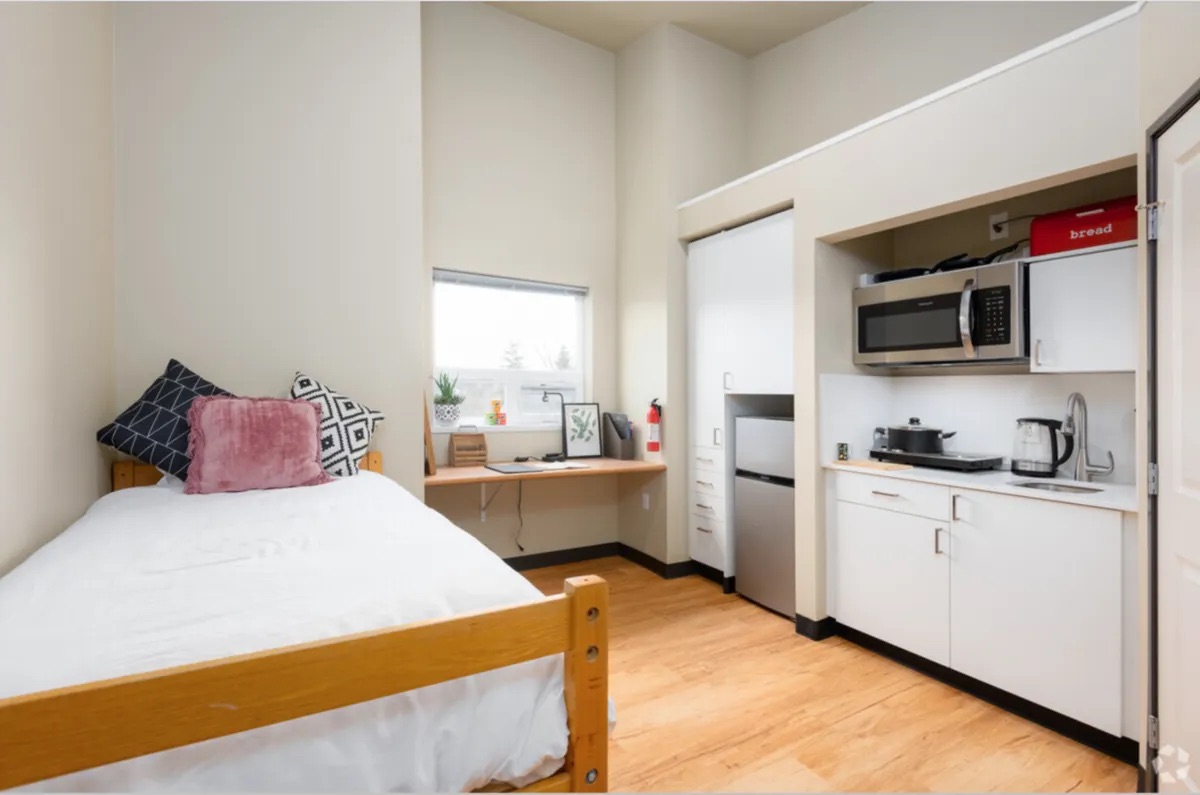
Micro-apartments are self-contained units that maximize vertical space with multi-functional furniture designed for small spaces, such as Murphy beds that fold into desks and kitchenettes. They are typically 150 to 400 square feet, and offer students an affordable, independent housing option near campus.
As the national average student housing rent climbs to $1,017 per bed and graduate student enrollment spikes, the ongoing urban affordability crisis has led to an increase in the use and construction of micro apartments.
The closer to campus, the higher the price tag. Properties within a half-mile of university grounds carry a 33% valuation premium over those farther away. To counter these costs, developers are shrinking floor plans to fit more students onto expensive plots of land, theoretically keeping individual rent prices from skyrocketing even further.
Despite the smaller footprint, these units aren’t always “cheap.” Because they require high-end, custom-built furniture and complex plumbing for individual bathrooms and kitchens, the cost per square foot is often higher than expected.
However, for many, their benefits outweigh the cost of living small. Traditional dorms bundle in mandatory university meal plans, which cost an extra $3,500 to $6,000 annually. Because micro-apartments include a private kitchenette, students can cook their own meals, which usually saves students thousands of dollars a year.
Additionally, the cost-to-benefit ratio could be worth it when compared to the broader housing market. If a student tries to get a standard one-bedroom or traditional studio apartment alone near campus, the national average jumps to roughly $1,500 to $1,800 plus per month. Micro-units are priced 20% to 30% lower than standard studios, making independent living affordable.
When the University of British Columbia debuted its 140-square-foot “Nano Studios,” they priced them at roughly 700 Canadian dollars (about $510 USD) per month. This completely undercut their own on-campus traditional dorm housing average of $1,000 per month and was half the price of a standard city apartment.
With tens of thousands of student housing beds scheduled to break ground nationally this year, the micro-apartment is moving from a niche real estate experiment to a campus staple. For the incoming class of 2026, learning to live with less may be a very affordable way to get an education.