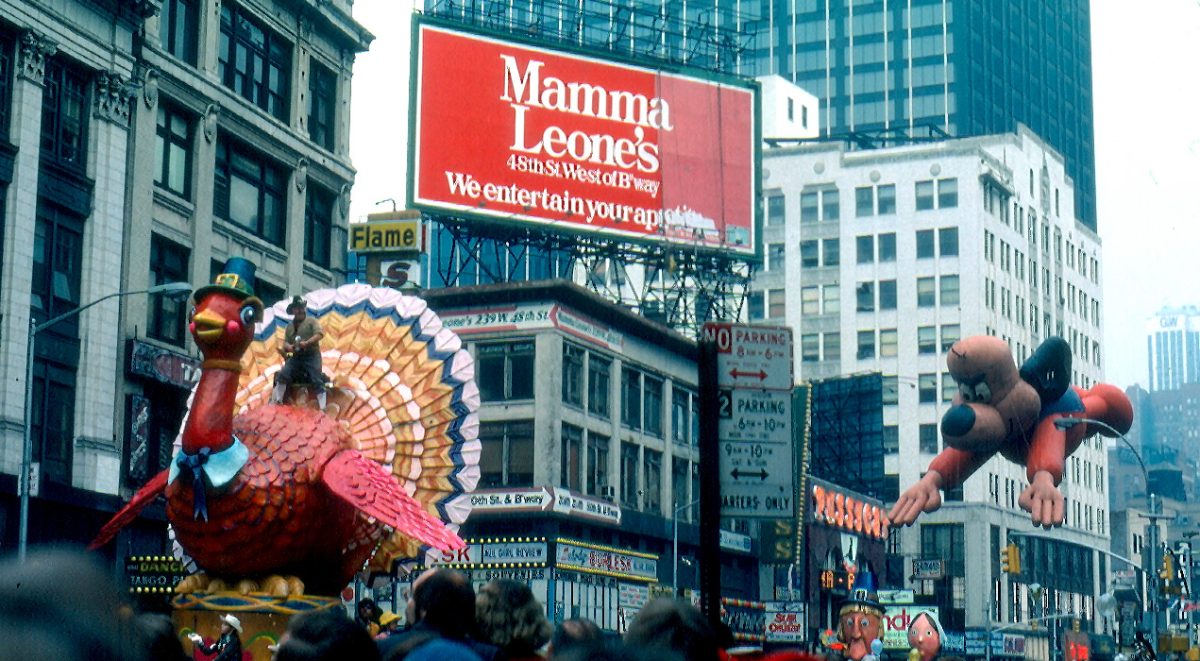
The Macy’s Thanksgiving Day Parade initially began in 1924 as a Christmas parade and originally featured live animals from the Central Park Zoo instead of balloons.
This parade was originally organized by Macy’s employees, many of whom were first-generation European immigrants. They created it to celebrate their new American home and to bring European-style festival traditions to the United States. Decades later, families all around the United States tune in early Thanksgiving morning to watch the parade. It was so successful that Macy’s announced it would be an annual event, eventually becoming a major American holiday tradition that was first televised in 1939. The parade switched to balloons in 1927 due to the animals being feared by children who attended.
Through the 1930s, the parade continued to grow, with crowds of over one million people lining the parade route in 1933. The parade was suspended from 1942 to 1944 due to World War II because rubber and helium were needed for the war effort. Marching bands have been a part of the parade since the beginning, but in 1958, the first celebrity performances were added, as the Benny Goodman sextet joined the parade. Some recent well-known celebrities include Shaggy, Meg Donelley, and Sean Evans. The addition of celebrities to the Thanksgiving Day Parade has made it widely known throughout the world. Technical and logistical difficulties marred many of the early attempts to perform live music on moving stages, and in 1964, the parade began transitioning to the infamous lip sync.
Safety changes throughout the 1990s to the 2000s changed the parade’s characteristics drastically, without losing the Thanksgiving charms it has always had. During the 1993 parade, strong gusts of wind pushed the Sonic the Hedgehog balloon into a lamppost at Columbus Circle. According to Wikipedia, the lamppost damaged the balloon, and the top of the post broke off while inside the balloon, dragging it down, injuring a child and an off-duty police officer in the process. Furthermore, in 2001, in the aftermath of the September 11th attacks, there were debates about whether to cancel the parade. With the lingering scent of burnt metal and the continued rescue efforts being done at the World Trade Center site, some people felt it was insensitive to host the parade. This debate sparked widespread controversy, with opposing opinions across the nation. The parade was later decided not to be cancelled.
COVID-19 drastically affected the parade as a whole. Due to the pandemic, the 2020 parade was downsized and closed to the public, being filmed as a broadcast-only event in the Herald Square area. There were 88 percent fewer participants, and social distancing was enforced. In recent years, the parade has changed in many ways, including in 2022, when the parade marked the first time that the broadcast was hosted entirely by women, and in 2023, when the parade started half an hour earlier, at 8:30 am, making it the first parade to begin earlier for almost a century. Though these changes seem small, they can become huge to entertainers and workers who have gone through the same schedule for the play for decades.