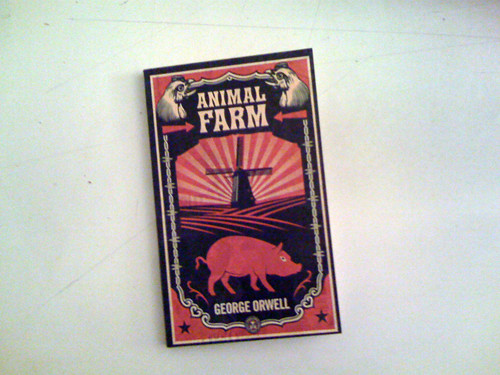
A book about communism turned into a children’s comedy.
The new adaptation of George Orwell’s Animal Farm has left critics enraged as it was not at all what most expected.
George Orwell’s Animal Farm is famous for being a dark, serious warning about how power corrupts. But the new adaptation does the unthinkable: it turns the communist allegory into a goofy comedy for kids. Critics are already slamming the project, arguing that trading the book’s famous political “bite” for cheap laughs isn’t just a bad creative choice, it completely misses the point of the story.
The decision to pivot to a children’s comedy strikes many as a direct violation of the book’s purpose. Orwell wrote with a “political purpose,” and stripping that away to make the story “palatable” for kids erases the danger he was trying to highlight. When we turn a story about the death of freedom into a series of slapstick gags, we lose the very warning the author intended to preserve.
“Every line of serious work that I have written since 1936 has been written, directly or indirectly, against totalitarianism and for democratic socialism,” George Orwell said.
The new writers are deliberately throwing away the project and prioritizing “cheap laughs” over meaningful substance, a creative choice that reflects a much deeper concern George Orwell held regarding the manipulation of language. By stripping away the story’s intellectual weight and simplifying the dialogue into a “goofy” comedy. This process of linguistic watering-down does more than just change the tone; it actively reduces the complexity of the narrative until the audience, particularly a younger one, loses the tools necessary to think critically about the subtle ways power and corruption take root. In Orwell’s view, when we lose the precision of our language, we lose our ability to recognize the truth, a form of linguistic decay he famously warned about.
In the original book, Boxer represents the loyal, hardworking working class. When he gets too old and injured to work, the pigs, who he trusted completely, sell him to a horse slaughterer to buy a case of whiskey. It is the most devastating, heart-wrenching moment in the story because it shows the ultimate betrayal of the people by their leaders.
The most iconic moment of the original book is the haunting realization that the animals can no longer tell the pigs from the humans. This new adaptation reportedly softens the ending to be “uplifting,” but Orwell’s point was that power is inherently transformative and often ugly. A comedy that refuses to show the “pig” in the “man” isn’t just a different version; it is a refusal to see the world as it actually is. It ignores the struggles Orwell wrote about and instead makes it digestible.
“To see what is in front of one’s nose needs a constant struggle,” Orwell said.